

Contents
- FUE vs DHI Hair Transplant: Which One Is Better for You?
- Why Choosing Between FUE and DHI Is Often Confusing
- What Is FUE Hair Transplant and Who Is It Best For?
- What Is DHI Hair Transplant and When Does It Make Sense?
- FUE vs DHI: Key Differences That Actually Matter
- Does DHI Really Give Higher Density Than FUE?
- Is One Technique More Natural Than the Other?
- Recovery, Scarring, and Long-Term Results Compared
- Which Technique Is Better for You Specifically?
- Final Advice: Stop Choosing Techniques, Start Choosing Strategy
One of the most common questions patients ask after deciding on a hair transplant is:
Should I choose FUE or DHI?
Unfortunately, this question is often answered incorrectly.
Many clinics present FUE and DHI as competing products, when in reality they are tools.
And like all tools, their value depends on how and when they are used.
This guide explains the real differences, without sales pressure, so you can make a decision that fits you, not a brochure.
Why Choosing Between FUE and DHI Is Often Confusing
The confusion usually comes from marketing, not medicine.
Some clinics promote DHI as:
- More advanced
- More modern
- More natural
Others push FUE as:
- More flexible
- More proven
- More cost-effective
The truth is simpler:
Neither technique is universally better.
The right choice depends on your hair loss pattern, donor area, expectations, and long-term plan.
What Is FUE Hair Transplant and Who Is It Best For?
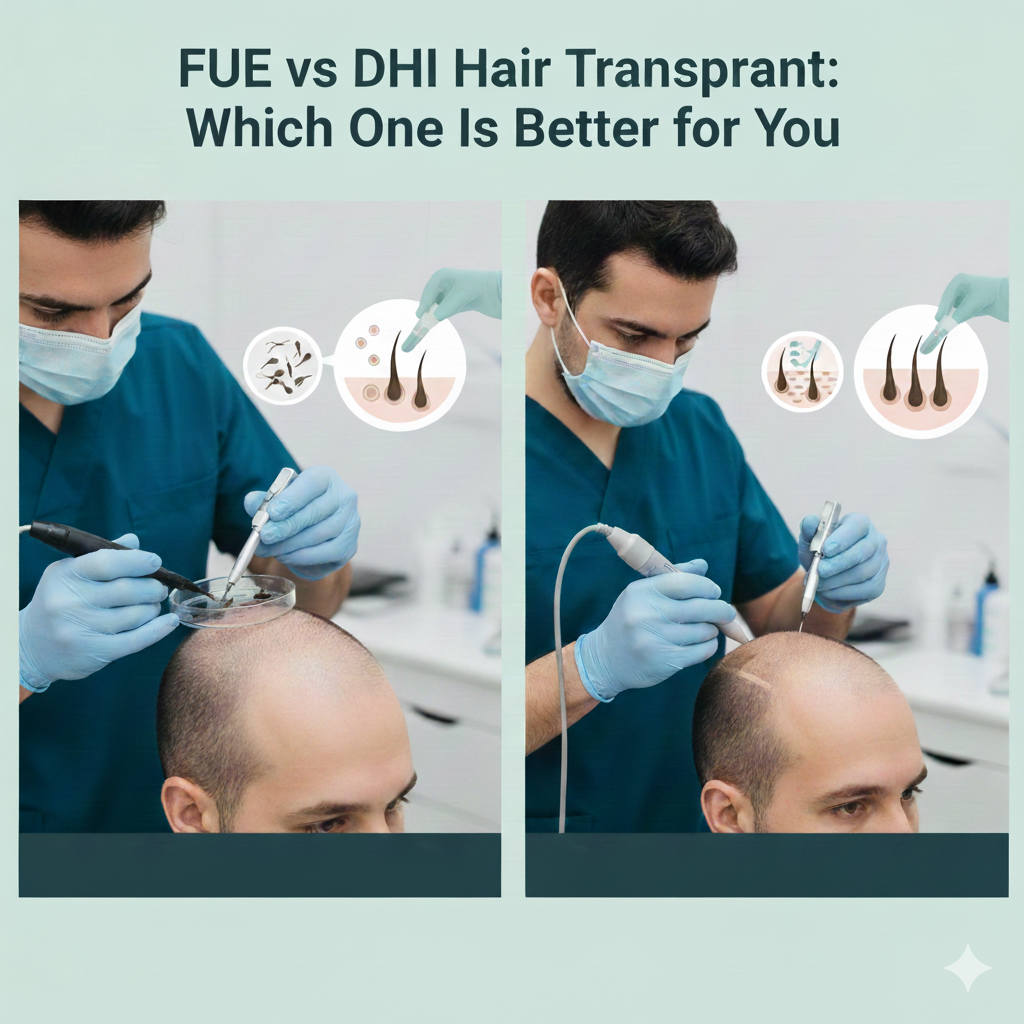
FUE, or Follicular Unit Extraction, involves extracting individual grafts from the donor area and placing them into recipient sites that are prepared in advance.
FUE is often preferred when:
- Larger areas need coverage
- Significant graft numbers are required
- Flexibility in design is important
- Long-term planning matters
Because recipient sites are created first, the surgeon has more control over:
- Hairline design
- Direction and angle
- Overall distribution
For many patients, FUE offers the most balanced and predictable approach.
What Is DHI Hair Transplant and When Does It Make Sense?
DHI uses a special implantation pen that allows grafts to be placed directly without opening recipient sites beforehand.
This method can be useful when:
- The target area is relatively small
- Precision placement is critical
- Existing hair density needs to be preserved
- Minimal shaving is preferred
DHI is not a replacement for FUE.
It is a variation of implantation, not a completely different procedure.
In experienced hands, it can be an effective option for specific cases.
FUE vs DHI: Key Differences That Actually Matter
From a patient perspective, the real differences are not technical terms, but outcomes.
The most meaningful differences involve:
- Area size that can be covered efficiently
- Surgeon control over hairline design
- Time required for the procedure
- Cost differences
- Long-term donor management
In many cases, clinics that offer only one technique recommend it for every patient. That is not ideal.
Does DHI Really Give Higher Density Than FUE?
This is one of the most common misconceptions.
DHI does not automatically create higher density.
Density depends on:
- Donor hair quality
- Graft survival
- Placement strategy
- Hairline planning
In some cases, DHI allows slightly closer placement.
In others, FUE achieves equal or better visual density through strategic design.
Density is not about the tool. It is about planning.
Is One Technique More Natural Than the Other?
No technique guarantees natural results.
Natural appearance comes from:
- Proper hairline design
- Correct angulation
- Consistent direction
- Experience of the surgical team
A poorly planned DHI transplant looks artificial.
A well-planned FUE transplant looks completely natural.
Technique does not replace expertise.
Recovery, Scarring, and Long-Term Results Compared
Both FUE and DHI:
- Leave minimal scarring when done properly
- Have similar healing timelines
- Require proper post-operative care
Long-term results depend far more on:
- Donor area preservation
- Conservative graft usage
- Planning for future hair loss
Neither method protects you from poor decisions.
Which Technique Is Better for You Specifically?
Instead of asking:
“Which technique is better?”
Ask:
- How advanced is my hair loss?
- How strong is my donor area?
- Do I need density or framing first?
- What will my hair loss look like in 10 years?
The answers to these questions determine the technique, not the other way around.
Final Advice: Stop Choosing Techniques, Start Choosing Strategy
FUE vs DHI is not the real decision.
The real decision is:
- Choosing the right plan
- Choosing realistic expectations
- Choosing experience over trends
A good clinic explains why a method suits you.
A bad clinic sells the method it happens to offer.
Choose strategy. The technique will follow.

Leave a Reply