

Contents
- Does Hair Transplant Really Work? Real Results, Timeline, and Expectations
- Does a Hair Transplant Actually Grow New Hair?
- How Successful Are Hair Transplants in Real Life?
- Hair Transplant Timeline: When Do You See Real Results?
- What Results Are Realistic to Expect?
- Who Is a Good Candidate for Hair Transplant?
- Why Do Some Hair Transplants Fail?
- Is a Hair Transplant Permanent?
- Final Verdict: Does Hair Transplant Really Work?
- Thinking About a Hair Transplant?
Hair loss is frustrating, emotional, and often confusing. If you are considering a hair transplant, the first and most important question is simple:
Does hair transplant really work?
The short answer is yes, but only when done correctly, on the right candidate, with realistic expectations.
In this guide, we will explain:
- How effective hair transplants really are
- When results become visible
- What kind of outcome you should realistically expect
- Why some people are happy with their results and others are not
This article is designed to give you clarity, not marketing promises.
Does a Hair Transplant Actually Grow New Hair?
Yes. A hair transplant works by moving genetically resistant hair follicles from a donor area, usually the back or sides of the head, to areas affected by hair loss.
These transplanted follicles:
- Are resistant to DHT, the hormone responsible for male pattern baldness
- Continue growing hair in their new location
- Behave like natural hair after the healing process
Once the follicles successfully settle and start growing, the hair is real, natural, and permanent.
However, overall success depends on several critical factors, which we will cover below.
How Successful Are Hair Transplants in Real Life?
When performed properly, modern hair transplant techniques have success rates above 90–95% follicle survival.
That said, success does not always mean:
- Instant density
- A teenage hairline
- Zero future hair loss
A successful transplant means:
- Natural-looking growth
- Permanent transplanted hair
- Improved density and facial framing
Patients who understand these limits are almost always satisfied. Those expecting miracles are not.
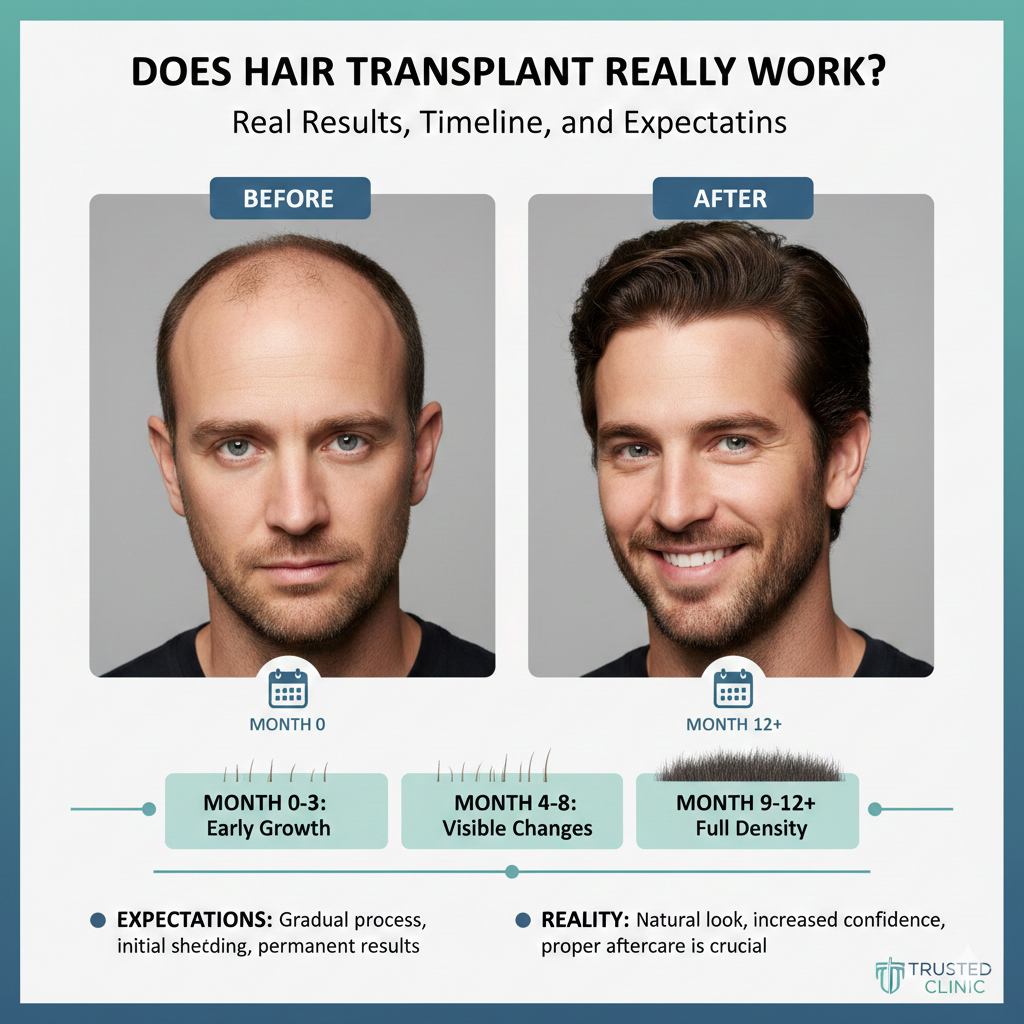
Hair Transplant Timeline: When Do You See Real Results?
One of the biggest misconceptions about hair transplants is expecting fast results. Hair restoration requires patience.
First 0–2 Weeks: Healing Phase
- Redness and mild swelling
- Small scabs around grafts
- Donor area begins healing
This stage is normal and temporary.
2–8 Weeks: Shedding Phase (Shock Loss)
- Transplanted hairs fall out
- Many patients panic at this stage
This does not mean failure. The follicles remain alive under the skin.
3–4 Months: Early Growth
- Thin, soft hair starts appearing
- Uneven growth is common
6–9 Months: Visible Improvement
- Hair becomes thicker
- Coverage improves significantly
12 Months: Final Results
- Full density and natural texture
- Hair can be cut, styled, and treated normally
Anyone promising instant full results is misleading you.
What Results Are Realistic to Expect?
A hair transplant can:
- Restore a receding hairline
- Improve crown density
- Frame the face naturally
- Make hair loss far less noticeable
A hair transplant cannot:
- Create unlimited density
- Stop future hair loss in untreated areas
- Replace hair that was never genetically strong
The goal is improvement, not perfection. Natural-looking results always outperform aggressive, artificial designs.
Who Is a Good Candidate for Hair Transplant?
Hair transplant works best for people who:
- Have stable or predictable hair loss
- Have a strong donor area
- Have realistic expectations
- Are generally healthy
It may not be ideal for:
- Very young patients with aggressive hair loss
- People with poor donor density
- Those expecting one surgery to solve hair loss forever
A proper medical evaluation matters more than the technique itself.
Why Do Some Hair Transplants Fail?
When people say “hair transplant doesn’t work,” it is usually because of one or more of the following:
- Poor donor management
- Overharvesting grafts
- Unnatural hairline design
- Inexperienced medical teams
- Lack of proper post-operative care
- Ignoring future hair loss planning
Hair transplant is not just a procedure. It is a long-term strategy.
Is a Hair Transplant Permanent?
Yes, the transplanted hair is permanent.
However:
- Native, non-transplanted hair can continue to thin
- Some patients may need medical support or future sessions
A good clinic plans for your future hair loss, not just today’s appearance.
Final Verdict: Does Hair Transplant Really Work?
Yes. Hair transplant works when done for the right person, in the right way, with the right expectations.
It is not magic.
It is not instant.
But it is one of the most effective and proven solutions for permanent hair restoration available today.
The most important decision is not where, but how and by whom the procedure is performed.
Thinking About a Hair Transplant?
Before making any decision:
- Understand your hair loss pattern
- Know what results are realistic
- Get a personalized evaluation
A successful hair transplant starts with the right information.



Leave a Reply